Our Stories Literary Journal
A Life in Letters
by Lex E. Santí
For seven years I ran Our Stories, a literary journal built on one creed: first, do no harm. It was the hardest work of my life: reading thousands of manuscripts, telling hard truths gently, paying people fairly for it — and turned out to be the truest training I ever had for what I do now. This is that story. Thank you for reading it.
It started with a dead cat
It started with a dead cat. That's how Our Stories started: a dead cat. Not my dead cat, mind you — I can't stand cats, I'm allergic to them. But there was a story, years ago, that opened with a man tramping through the snow outside Chicago carrying his girlfriend's dead cat and a shovel, on his way past the city limits to bury it. I loved that story. I loved everything about it except the ending, which fell apart over the last four pages. I told my editor we should publish it and ask the writer to fix the ending — I said I'd be willing to work with the guy. My editor said no. The writer got a scribbled note on a rejection slip, and that was that.
That dead cat got me thinking that there was something deeply wrong with the way literary journals accept and reject stories. And in 2006, with a dollar and a grudge and an idea I still believe was right, I founded a journal to do it differently.
The grudge was earned honestly. I had studied fiction at George Mason University, where I took my MFA under Richard Bausch and Alan Cheuse — two writers who shaped me more than I can fit into a sentence. I had sat on the boards of literary journals as an undergraduate and a graduate student, at Phoebe and So to Speak. I knew the work from the inside. I knew that every reader at every journal always knows — one hundred percent of the time — exactly why a story is being rejected, and that under the prevailing system the writer never finds out. The SASE comes back. The slip says no. The writer goes back to square one, not knowing whether they missed by a mile or by a single paragraph.
There's something wrong with the system. It doesn't make any sense to me. It shouldn't make any sense to you, really, it shouldn't. Here's the first thing you should know: there's no such thing as a slush pile, at least not with us.
That was the founding promise. We were the journal that says maybe. We read every page. We responded to the whole story, not a few lines. If a piece came in and we saw its potential, we asked the writer to revise it with us. A good editor, I believed then and believe now, says maybe and takes the time to see what the author is actually trying to say.
Abilities for your needs


.jpg)
The philosophy had a name, or near enough to one. I used to end essays with a phrase that became a kind of motto: we have abilities for your needs. It came from a simple conviction — that some people have hard-won skill, and others have a genuine need for it, and that the humane thing, the right thing, is to connect those two honestly and without exploitation.
My staff were trained readers. Most of them had MFAs. They had spent years learning how to sit with a manuscript and understand not just whether it worked but why, and what could be done about it. That knowledge had value, and I refused to pretend otherwise. So when we charged a fee for a contest or a workshop, the great majority of that money went directly into the pocket of the staff member who did the reading. On our page-by-page contest reviews, eighty-three percent of the fee went to the reader. After the PayPal cut, that worked out to something close to minimum wage for two or three hours of careful work — which was not much, but it was honest, and it was real, and it meant no one was being asked to give their labor away for nothing.
I had no patience for the alternative. The literary world was full of operations that took twenty dollars from a writer and gave back a form rejection — a high-brow Ponzi scheme, I called it more than once, and I meant it. I told writers plainly: be wary of any contest that asks for your money and promises you nothing in return. If you are going to part with your hard-earned money as a writer, give it to the places that will give you something real back — feedback, a read, a human response — and make sure that money is going into the pocket of the person actually doing the reading, not into the coffers of someone running a grift on the dreams of people who love literature.
I sleep easy knowing that I do not sell the dream of getting published, but that my staff gives honest assessments to one hundred percent of everyone we don't publish. This is Santí's Law: the literary marketplace should equally support art and the future development of art in a grassroots model, bringing qualified and learned opinions to those who need them most — without exploiting labor, so that the management of art remains humble and true.
This was a humanistic journal. It was, frankly, a radical idea — and I think it's fair to say it died, in the end, because the wider world preferred the grift. The mass migration I kept waiting for, the uprising of writers who would say enough, I want feedback for my money — it never came the way I imagined. I wrote about that disappointment openly, again and again, in my quarterly letters from the editor. But I have never once doubted that the idea was correct.
What I wrote in the margins of seven years
Every issue of Our Stories opened with a letter from the editor — which is to say, an essay by me about the craft and the business of writing. I wrote dozens of them between 2006 and 2013. They were not lectures so much as field reports: the things I found myself repeating to writers, quarter after quarter, until they hardened into something like a philosophy.
I wrote about the fantasy every young writer carries — the Unkie Editor complex, I called it. The naïve belief that somewhere a warm, cigar-smoking, bear-hugging editor is sitting by his rotary phone, thrilled and weeping, waiting for your story and only your story.
We believe our story is the only story that the editor will read when you send it. The only story that is important. The only story that they're going to care about.
The truth, I told them, is closer to Cousin Jimmy Bob — an ornery man on a porch in the Alabama heat with a stack of thirty manuscripts and a shotgun for the first poet who walks up his drive, reading until he finds the one mistake that lets him stop. Because it only takes one mistake. One confusing sentence on the first page, one word out of order, and at most journals the ballgame is over. So I gave the practical medicine alongside the parable: use a standard font, double-space the thing, paginate it, and for God's sake make the first three pages move. Richard Bausch had a mantra he would shout at us in workshop — the short story is a war — and what he meant was that the story has to move, it has to earn the next page.
I wrote, more than anything, about revision — because revision is where writing actually happens. The first draft is always the sexiest; it's the flash of inspiration that rips through you and makes you scream yes, yes, yes. And then the real work begins. I described the brutal second self I'd let into the room once a draft was done: the structural engineer, the anti-artist, the one who turns on Track Changes and questions the premise of the whole thing line by line. The true blood of writing, I always said, is taken out by the eraser, not the pencil.
But the same breath that demanded revision also demanded humility about it, because perfection is an illusion. I told the story Bausch told me — about being caught in an error by a critic, feeling an inch tall, and then E.L. Doctorow leaning over to say, Ahh, Richard, perfection is an illoooosion. With millions of word combinations and the imperfect machinery of the human mind, you cannot get it perfect. You can only get the first few pages as clean as possible, get a good story going, and trust the reader to forgive the rest.
I wrote about character — that the protagonist is the lifeline you have with your reader, the vessel through which all the moral and emotional weight of a story is carried, and that you must never treat your characters as though they don't matter. Allen Wier once told a workshop I was in: you need to respect your characters and give them some dignity. I wrote about the wild, blindfolded flailing of beginning a story at all — swinging a heavy stick at a piñata with a bandana over our eyes, hoping to knock something loose — and about pausing, before the second page, to ask whether you're telling it the right way before you build a hundred roadblocks you'll have to tear down later.
I wrote about the three things I believe all good fiction must have — meaning, sense, and clarity — a formulation I borrowed from Frank Conroy and made my own by applying it to other people's manuscripts for years. I wrote about being clear before you sit down to write, about tending the friendships and the worries that would otherwise sit on your shoulder and poison the hour. I wrote about the courage it takes to make yourself understood — an idea I first learned not in a workshop but in Romania, in the Peace Corps, trying to explain a hammock to someone in a language I barely had, landing finally on pot en aer, a bed in the air, and understanding that all writing is exactly that: the audacious attempt to make visible something that exists only in your own mind.
I wrote about ambition and fear — about how, at some point, you have to be willing to throw it all away, to stop writing for the crowd and the professor's praise and write instead for your own stubborn self. I am not a painter, I wrote in one of the essays I'm fondest of, borrowing Frank O'Hara — I'm a writer, because it's the only thing that makes me feel most like myself; and writing this brutal, solitary, beautiful profession is survivable only if you do as Bausch said and simply stay alive, and keep working at it. And I wrote about the patient truth that we are not born into this craft: there has never been a child prodigy of the short story, because the great work requires life lived behind the words, and time, and draft after draft after draft. Not by birth alone will it happen.
Some of the letters were not about craft at all. When I felt myself drifting, I wrote about needing the concrete — real friends, real goals, real lakes and real grief. And in the fall of 2007, after my stepfather was killed when a van crossed in front of his motorcycle on a clear upstate morning, I wrote the hardest thing I ever published.
The people of Our Stories
A journal is its people, and I was luckier in mine than I had any right to be. A staff of fifteen, scattered across the country and the world, most of whom I never met in person, all of whom I trusted completely. They were a group of all-stars tied together by a single conviction — that the writers who came to us deserved to be read.
M.M. De Voe was our Associate Editor, and she brought a ferocity of purpose that matched my own. Her MFA was from Columbia, where she studied under Michael Cunningham and Helen Schulman, among others, and her short fiction has won a staggering list of prizes — the Raymond Carver competition, Fish Publishing's prize, three Pushcart nominations, and more. She understood from the inside what it meant to be a serious writer moving through a system that mostly treated emerging voices as inconveniences to be processed. She went on to found Pen Parentis in New York City, an organization devoted to supporting writers who are also parents — built on the same humanist conviction that drove Our Stories: that writers deserve community and mentorship, not just competition and rejection. Watching her build that institution has been one of the quiet satisfactions of my life in letters.
Justin Nicholes was our Communications Director and ran the blog, among many other things. His novel Ash Dogs was a finalist in the 2009 Next Generation Indie Book Awards, and his fiction appeared in SLAB, Slice, and Karamu. He had an editor's mind — precise, generous, willing to go line by line through a manuscript with the full care it deserved, and he conducted some of our interviews. He is now an established English professor, carrying that same ethic of careful reading and honest feedback into classrooms full of writers who are lucky to have him.
Kendra Tuthill, our Assistant Editor, became one of my closest readers and collaborators, with an eye for story that was almost frightening in its accuracy. A George Mason graduate who had already written four novels and staged her own plays in Washington, she has gone on to a significant and accomplished career in the film industry — a different medium, the same exacting instinct for what a scene is really doing and what a story is actually about beneath its surface.
Elizabeth Kadetsky directed our book publishing. Even then she was the most credentialed among us — author of the memoir First There Is a Mountain, a Fulbright scholar, with fiction in the Pushcart Prizes and Best New American Voices. She has since become a professor of creative writing at Penn State and nonfiction editor at New England Review, and her lyric memoir The Memory Eaters won the Juniper Prize. That she lent her name and her labor to a scrappy upstart journal still moves me.
And the readers — the heart of the operation. Kseniya Melnik, who read fiction for us and taught in our online workshops, has since published the acclaimed linked collection Snow in May, shortlisted for the Dylan Thomas Prize. Steven Ramirez came to us from the Iowa Writers' Workshop, having studied under T.C. Boyle, and helped run our regional workshops in Chicago. Want Chyi, with her MFA from Arizona State and her years editing Hayden's Ferry Review, read for us from Singapore and Chicago and beyond. Cheri Johnson, a Bush Artist Fellow and Fine Arts Work Center fellow, read fiction and poetry alike. Katherine Gehan read from Boston with her Emerson MFA. Joseph Nalbone served as our Future Initiatives Director, bringing a science-fiction writer's mind and an interest in mindfulness to the question of where the journal might go next. CJ Moutinho — by my own description a genius, the only man I knew who could figure out anything technological again and again — built our iPhone app. And Josh Campbell, my best friend, who founded the journal with me, who was better at grammar than I ever was or wanted to be, and who reworked manuscripts with a patience I admired.
Every one of them believed in the strange humanistic experiment of the thing with a stubbornness that still moves me. They worked hard, for modest pay that I insisted on paying anyway, and they made the journal what it was.
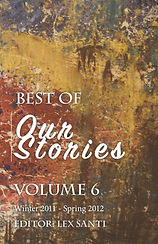
We talked, in those years, with some of the finest writers alive. Our Interview with a Master series ran conversations with Richard Bausch, Alan Cheuse, Stuart Dybek, Adam Haslett, Steve Almond, George Saunders, Matthew Sharpe, Paul Cody, Stacey Richter, Ana Menéndez, T.C. Boyle, Junot Díaz, Karen E. Bender, Richard Spilman, and Cara Hoffman, among many others. Beyond the journal's own pages, my work and the Our Stories mission drew notice elsewhere: a conversation with Jim Harrington for his Six Questions blog in 2010, an interview in our own pages conducted by my staff, a profile in The Review Review, an interview for the Simon & Schuster blog by Cara Hoffman, a piece in the Pulteney Street Survey, and a profile on the George Mason fiction program's blog. We published six print volumes of the Best of Our Stories anthologies, collecting the finest short fiction we could find, and those books remain in print to this day.
A karmic pursuit, and a training ground
Running Our Stories was the most demanding labor of love of my life, and I mean that without irony. It was also, though I didn't fully understand it at the time, the truest training I ever received for the work I do now.
I believe in karma — in the plain sense that what you put into the world is what shapes you. Every story I read carefully, every writer I told the truth to gently, every staff member I paid a fair wage and treated as the skilled professional they were, was a deposit into something I couldn't yet name. I know now what it was. Running that journal taught me how to sit with people.
That sounds simple. It is not. To sit with a writer whose story isn't working and tell them so without extinguishing the very impulse that made them write it — that requires everything a therapist also needs. Patience. Precision.
The ability to hold both the truth and the person in the same moment without letting either one damage the other. I learned to listen for what a piece was trying to do before I judged whether it had done it. I learned that careless criticism can close a person down for years. I learned that feedback is an act of relationship, not merely an act of assessment — and that the creed of the workshop, like the creed of the physician, is primum non nocere: first, do no harm.
It is my job to tell you that I heard you, that I was listening. I send a message back from the shore, skipping a rock back to you. We do no harm. We are here to help. We do not speak in certainties or extremes; we speak in touches, small edits, suggestions, insight into what you're telling us.
By the time I sat down for my clinical training, I had already spent years doing a version of therapy — sitting with thousands of writers in their most exposed moment, the moment of having made something and offered it up to a stranger. Writing and therapy, I've come to understand, are the same practice. Both are about paying attention to what is actually there rather than what would be easier to see. Both require the courage to name it. And both rest, finally, on the belief that the person in front of you has something worth hearing, even — especially — when they haven't yet found the words.
Begin, again
By 2012 I could feel the weight of it in a way I no longer knew how to carry. The margins had always been thin and the hours brutal, and my own life had moved through enormous change — a move from St. Louis back to Ithaca, the end of one chapter and the start of another, a novel that needed finishing. I wrote honestly about where the journal was headed and, eventually, about letting it go. I had always told writers to begin, again — to revise the opening, to keep circulating the work, to never file a story in a drawer and call it dead. I had to take my own advice about my own life.
Our Stories closed in 2013. The website is gone now. But the books remain in print, and the writers we read are still writing, and the people who built it with me went on to build things of their own that carry its fingerprints — M.M. in New York, lifting up writer-parents; Justin in the classroom, shaping the next generation; Kendra in film, still knowing exactly what a story needs.
I did not set out to build a legacy. I set out to fix a broken system, one honest response at a time, because a dead cat in the snow made me angry enough to try. Whether I succeeded is for others to say. What I know is that I tried to do it right. That I paid people. That I told the truth. That I showed up, issue after issue, essay after essay, for seven years, in service of writers who deserved better than silence.
It was a good way to spend a life in letters. I'd do it again.
In memory of David E. Husted, June 9th, 1959 – September 19th, 2007


